
Deepfake Protection for Email: The Solution for 2026
Contents
The new threat changing the rules
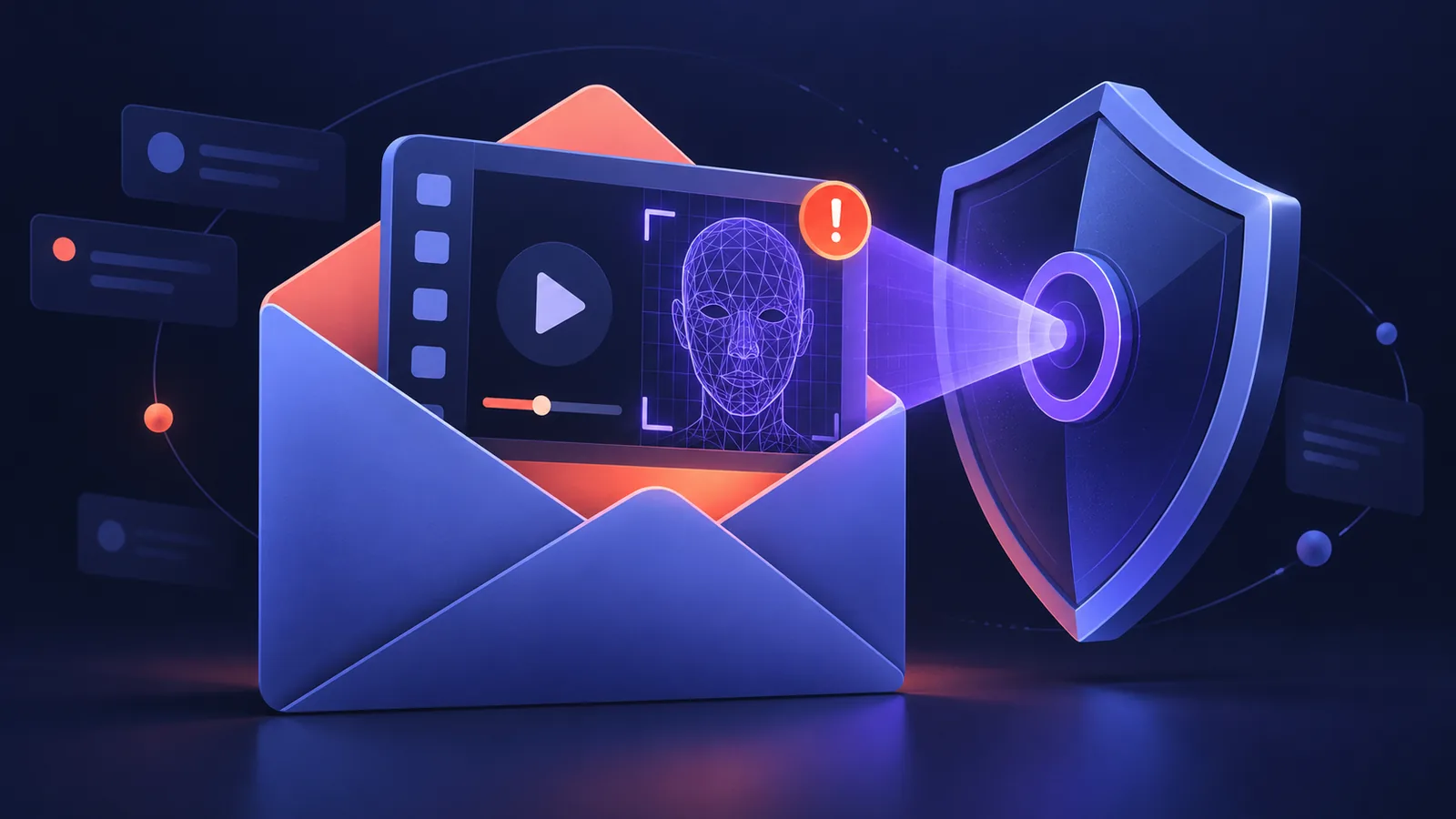
In 2026, email is no longer just a means of communication. It has become one of the main attack channels for cybercriminals worldwide. Using deepfake technology, which creates fake images, videos, and voice recordings with artificial intelligence, attackers can produce exceptionally credible and persuasive messages.
Imagine an email that appears to come from your company's CEO, containing a video or voice message asking for an urgent money transfer. In many cases, even experienced employees struggle to recognize the forgery.
Losses from deepfake attacks already total hundreds of millions of dollars each year, and the trend is worsening. Traditional technologies such as spam filters, SPF, DKIM, and DMARC continue to provide an important layer of protection, but cannot address this new threat alone.
How are deepfakes used in email attacks?
Attackers now incorporate deepfake capabilities into particularly sophisticated Business Email Compromise attacks.
Fake videos and attachments
An email containing what appears to be a personal video from a senior executive, customer, or business partner.
Links to fake meetings
Invitations to Zoom, Teams, or Google Meet calls that use real-time deepfakes.
Generative AI integration
Creating linguistically flawless text, using accurate personal details, and presenting an entirely credible business context.
The combination of visual content, voice, and text creates a much more persuasive attack than traditional phishing and significantly increases attackers' success rates.
The solution for 2026: deepfake detection within email security systems
Information security experts agree that the future lies in integrating deepfake detection directly into corporate email security systems.
IRONSCALES: a pioneer in the field
In 2025, IRONSCALES launched one of the first solutions designed to detect deepfake content as part of email protection.
IRONSCALESHow does the system work?
Advanced AI systems scan video and audio files arriving by email, looking for signs of manipulation, such as:
- Inconsistent facial features
- Unusual lip movements
- Unnatural lighting and shadows
- Irregularities in voice patterns
- Hidden biometric indicators
The checks take place in real time, before the user encounters the content.
Other leading platforms
Several leading companies operate in this field alongside IRONSCALES:
Reality Defender
An enterprise system for real-time deepfake detection in video, audio, and images.
Reality DefenderSensity AI
An advanced detection platform providing forensic analysis and reports suitable for legal use as well.
Sensity AIPindrop
Specializes in detecting fake voices and voice impersonation attacks.
PindropIntegrated security solutions
Major security providers are gradually incorporating deepfake detection into their protection platforms, alongside advanced behavioral analysis of email messages.
Recommended protection layers for organizations in 2026
The technology layer
- Deploying a deepfake detection system at the corporate email gateway
- Using multichannel analysis covering video, audio, text, and metadata
- Adopting content authentication standards such as C2PA and digital signatures
Organizational processes
- Out-of-band verification for financial or sensitive requests
- Calling back before taking critical actions
- Establishing dedicated verification mechanisms for emergencies
Employee training
- Deepfake simulations as part of information security awareness training
- Recognizing warning signs such as unusual urgency or unexpected requests
- Developing critical thinking even when content looks entirely credible
A Zero Trust approach
Even when a message looks completely legitimate, it should not be assumed trustworthy without additional verification of identity and permissions.
Looking ahead
Several major trends are expected by the end of 2026:
- A significant share of online content will be created using AI
- Deepfake detection will become a standard component of email security systems
- Regulators worldwide will tighten requirements for labeling and authenticating AI-generated content
- Organizations will be required to demonstrate advanced protections against AI-based impersonation
Conclusion
Deepfakes have become one of the most significant threats to email security. As AI technologies improve, so do attackers' impersonation capabilities.
The most effective response combines advanced detection technologies, strict operating procedures, employee training, and Zero Trust principles.
Organizations that adopt a multilayer approach today will have better protection, reduce their exposure to fraud, and be better prepared for cyber threats in the coming years.
A practical recommendation
Assess now whether your organization's existing email security solution can detect deepfake content. If it cannot, consider starting an evaluation and implementation process for AI-based solutions designed to detect advanced impersonation before the next attack reaches your inbox.
Further Reading
 Artificial Intelligence
AI Is No Longer Just Writing for Us: It Is Helping Us Learn to Speak
 Artificial Intelligence
AI News in 2026: Artificial Intelligence Moves from Excitement to Work
 Artificial Intelligence