
AEO/AIO Optimization: How Online Stores Become Part of AI Answers
Contents
- TL;DR: what a store must do to appear in AI answers
- How can a store appear within AI answers?
- How an answer engine chooses sources
- The new model for stores: problem, solution, product
- A practical example: how a store becomes an answer source, not just a catalog
- What should you build on your website to get AI to cite it ?
- An AEO checklist for stores
- What a store's presence in AI looks like in practice
- Common mistakes that keep stores out of answers
- How to make progress with AEO/AIO
- Frequently asked questions about AEO/AIO for stores
- Conclusion
In one sentence: To appear in AI answers, a store must build problem-solving pages, open each page with a short answer, and demonstrate credibility plus structure (FAQ + Schema) that answer engines can cite.
If you arrived here through a question rather than a "regular search," that is exactly the point. This article is written the way answer engines like to read: an early answer, a clear structure, and real questions from store owners. In other words, it does not just discuss AEO/AIO. It already uses it.
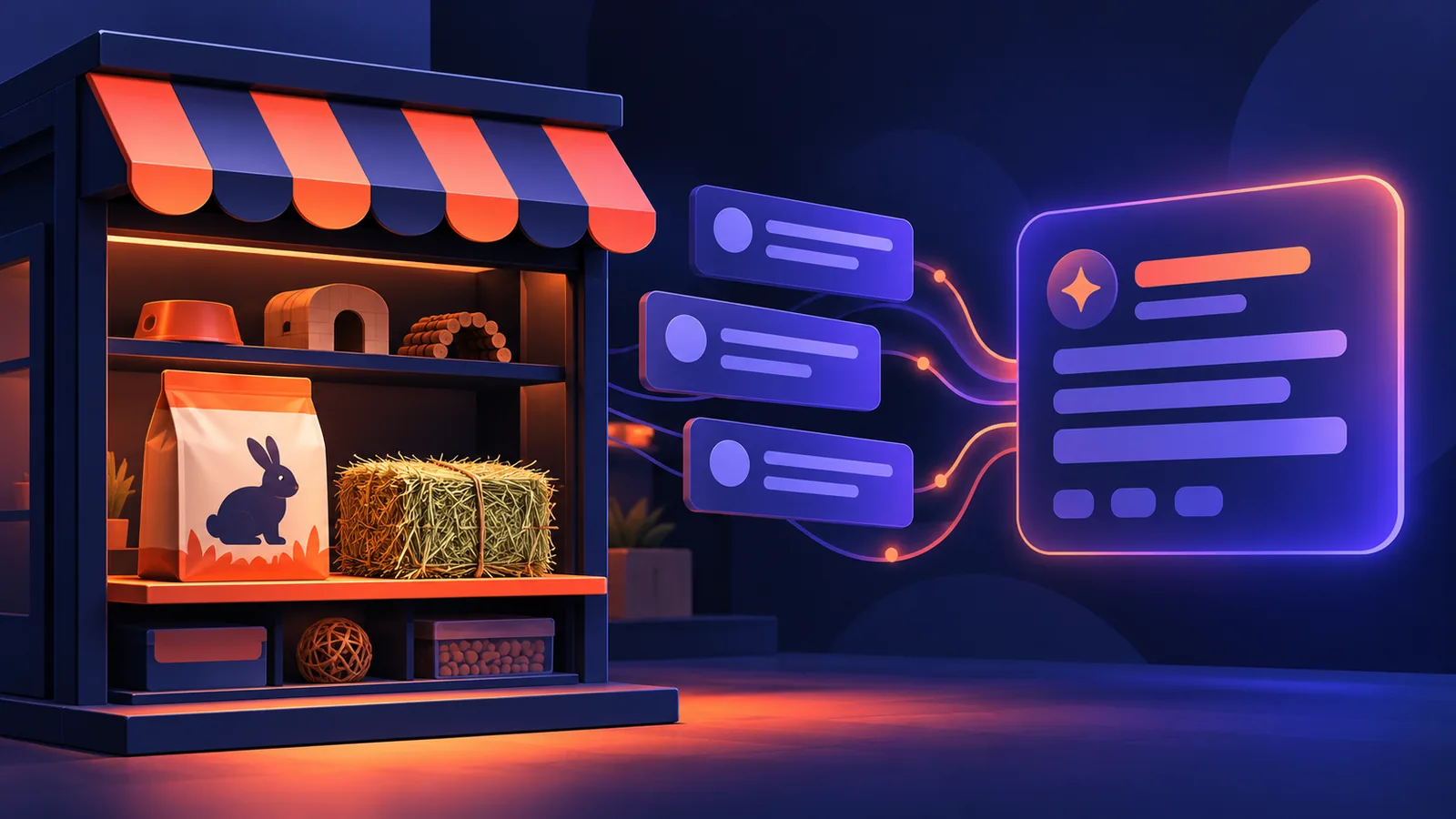
Search is changing. More users are skipping searches like "rabbit hay price" followed by comparing 10 results. Instead, they simply ask: "Which hay is best for a picky rabbit?" / "How do you switch foods?" / "Which pellets prevent selective eating?"
AI engines provide one answer: organized, decisive, and action-oriented.
This is where two terms that can no longer be ignored come in:
- AEO - Answer Engine Optimization: making your content the "answer" that answer engines choose.
- AIO - AI Optimization: making your website credible, structured, and useful enough for models to use it, and sometimes direct users to it.
The implication for store owners is simple: those who understand how to become part of answers gain exposure even without traditional clicks. Those who do not remain in the keyword race alone.
TL;DR: what a store must do to appear in AI answers
- Build pages around problems and questions, not just categories and products.
- Open each page with a short answer of 3-5 lines.
- Add genuine customer FAQs, not SEO-driven ones.
- Strengthen business credibility: who is behind the website, policies, and consistency.
- Implement schema (FAQ/Organization/Product/Breadcrumb).
- Organize an internal hierarchy that shows AI where the main answer is.
How can a store appear within AI answers?
Traditional SEO still matters, but an answer engine is not looking for "a page that ranks." It is looking for a source from which it can cite an answer. If your page is a catalog or generic text that tries to cover everything, AI struggles to extract something clear: what the problem is, what solves it, and what action to take.
In practice, AEO/AIO requires the website to function as:
- A short guide that leads to a decision
- A collection of answers to real problems
- A source that appears credible, consistent, and accurate
How an answer engine chooses sources
It is not magic, and it is not just about "ranking." Answer engines look for a combination of:
- Clarity: is there an immediate, clear answer?
- Structure: can the heading, answer, and context be understood?
- Specificity: does the page answer one question well, or speak in generalities?
- Credibility: is the business real? Is its information consistent? Are policies and details available?
- Practical purpose: does it help someone make a decision, or merely "explain"?
Once your website consistently provides these elements, it starts functioning as a source engines like to cite.
The new model for stores: problem, solution, product
Instead of a journey from product page to price to purchase, the visitor arrives through a question. The winning structure is therefore:
1) A problem or question page
For example, in the rabbit niche:
- "How do you switch a rabbit's food without upsetting its stomach?"
- "Picky rabbit: how do you choose the right hay?"
- "Uniform pellets: why do they prevent selective eating?"
2) A short answer at the top
3-5 lines in natural language, without preambles.
3) A brief explanation plus decision-making tips
What to check, what not to do, and when to stop and seek advice.
4) Product solutions or a relevant category
A logical match, rather than a sales push: "If this is your problem, these are the types of products that fit."
A practical example: how a store becomes an answer source, not just a catalog
To understand what AEO/AIO looks like in practice, think of a store that does not try to compete for every search term, but builds a layer of content around real problems, such as Refaeli Deliveries, a store for rabbit and rodent food and supplies that connects this content naturally to categories and products.
The reason this works is simple: instead of relying only on category and product pages, the right structure lets AI engines extract an answer: a problem, a brief explanation, what to do, and a suitable product or category. When this is written clearly, without promotional language and with a clean hierarchy, the website becomes a source that can be cited.
What should you build on your website to get AI to cite it?
1) A question cluster around each main category
Every niche has 10-30 recurring questions. These are the pages that will bring real exposure.
An example from the pet supplies niche:
- Nutrition (switching foods, sensitivities)
- Hay (types, picky eating)
- Pellets (uniform/nonuniform)
- Bedding (dust, odor, sensitivity)
- Teeth/digestion (when to stop handling it yourself)
The store is not "advertising." It starts with a problem and ends with a decision.
2) A short answer at the top of every page
Do not start with a story. AI wants to know "what to do."
A simple template:
- What to do (1-2 sentences)
- What not to do (one sentence)
- What to choose (one sentence)
- When to consult a veterinarian or specialist (if relevant)
3) Genuine FAQs
5-8 questions that sound like WhatsApp messages from customers, rather than an exercise in wording variations.
For example:
- "How many days should a food transition take?"
- "How can you tell the pellets are unsuitable?"
- "What is a sign that you should stop?"
4) Schema for machine readability
To provide structure:
- Organization / LocalBusiness
- Product
- FAQPage
- BreadcrumbList
Important: Schema does not guarantee inclusion, but it improves readability and context, helping machines understand what they see.
5) An About page and business details that establish an entity
In AIO, credibility is a prerequisite. A store that wants to appear in answers needs to show:
- A clearly defined business
- A clear area of expertise
- A service or delivery area
- Customer service
- Shipping and returns policies
AIO is about identity as well as content: consistent details, a steady professional voice, and evidence that you really are what you claim to be, rather than a website trying to be everything.
An AEO checklist for stores
- A problem page for every recurring question
- A short answer at the top of the page
- Genuine FAQs
- Clear business details and policies
- Basic schema that identifies the structure
What a store's presence in AI looks like in practice
The next step after "appearing" is becoming part of the decision. That happens when the website has:
- Answer pages focused on a solution
- Products presented in context, not in isolation
- Text about everyday use ("what this means at home")
In other words, a small decision-making page instead of another product page.
Common mistakes that keep stores out of answers
- Writing overly general articles without specific problem pages.
- Opening every page with a long introduction.
- FAQs that are just keyword variations.
- A weak or empty About page.
- Categories without context, containing only products.
- Links that look like advertising instead of an example within an explanation.
How to make progress with AEO/AIO
- Choose the 10 questions customers ask most often.
- Create a problem, solution, and suitable-product page for each question.
- Put a short answer at the top of each page.
- Add an FAQ with 5 questions.
- Link internally with purpose: problem pages to categories/products to another problem page.
- Implement basic schema.
- Improve your About page and policies.
Frequently asked questions about AEO/AIO for stores
Does this mean SEO is dead?
No. SEO remains the foundation. AEO/AIO add a layer: becoming an answer, not just a result.
Do you need to write a lot of content?
No. You need to write precisely. 10-20 good problem pages can provide more value than 100 generic posts.
Can product pages appear in AI answers, or are problem pages essential?
Product pages can appear, but they are usually not enough on their own. An answer engine looks for context and a decision: problem, criteria, and fit. Problem pages are the most direct way to turn a store into a citable source.
How do you measure whether AI has started using your website as a source?
Look for indirect signs: more branded searches, more direct visits, an increase in "how/what/why" queries, and better performance on problem pages. At the same time, track appearances in tools that display citations or sources, where available, and manually check key queries relevant to your niche.
Does this replace links?
No. But it changes their role: links strengthen authority, while content provides material to cite.
Conclusion
AEO/AIO is not a new trick, but a change in form: a store that organizes answers so they can be cited becomes part of AI answers, increasing exposure, brand presence, and purchases.
If you noticed, this article follows exactly the same logic: one answer at the top, an action-oriented TL;DR, headings phrased as questions, a checklist ready to cite, and FAQs that answer directly. It is not just an article about AEO/AIO. It is already a working example.
Further Reading
 Artificial Intelligence
Being Cited Is Not Enough: How to Get ChatGPT, Gemini, and Perplexity to Recommend Your Brand
 Artificial Intelligence
Deepfakes in Advertising and Marketing: The Growing Cyber Threat in 2026 and How to Respond
 Artificial Intelligence